Halka kokoreç
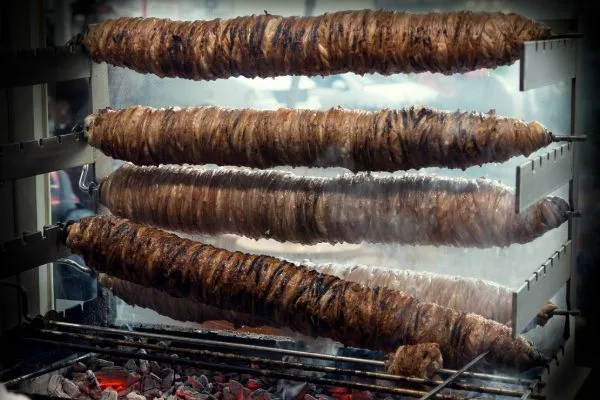
The ring of lamb intestines wound on the spit, grilled over charcoal and chopped to order.

İzmir, Turkey
Turkish · $$–$$$
Hours
Mon–Sat: 11:30–20:00
Sun: Closed
These are the hours of the central Şemikler shop, which is shut on Sundays. The Bornova shop stays open until 22:00 and the Bostanlı shop until 01:30, and both of those are open on Sundays.
Check availability below.
Confirm current hours, menu and reservation availability before visiting.
Visit websiteThe ring of lamb intestines wound on the spit, grilled over charcoal and chopped to order.
Kokoreç wound on metal skewers and grilled the same way over charcoal.
The house version with a strong spice mix; the family calls kokoreç a harmony of spices.
Sweetbreads cut as badem and grilled.
Sweetbreads cut as boğazlık and grilled.
A whole spit of lamb kokoreç, two blocks weighing about 2.8 kg, sold cooked and vacuum-packed for the trip home.
Kokoreççi Baki Usta is a family kokoreç shop in İzmir. The Şemikler shop in Karşıyaka is the one it grew from. Baki Usta was born in 1956 and spent his childhood in Çanakkale. He learned pastry work at Vardar Pastanesi in Kahramanlar, sold his own börek and poğaça from a hand cart, and then learned to wind kokoreç by watching a kokoreç cook do it once. In 1982 he began selling kokoreç from a cart in Şemikler. In 1991 he took a shop of seven or eight square metres. The family moved to the present central shop in 2005, and his son Volkan Usta, who had worked beside him since 2000, opened the Bornova shop in 2011 and the Bostanlı shop in 2015. All three shops are run by the family. There is no franchise. The menu is short and built on lamb. Halka kokoreç is the ring of intestines wound on the spit and grilled over charcoal. Şiş kokoreç is skewered. Atom comes with the house spice mix, and the family describes kokoreç as a harmony of spices. Uykuluk (sweetbreads) is sold as badem and boğazlık cuts. The lamb mostly comes from Balıkesir, from animals that graze on thyme, mint and other herbs, and every step from cleaning to winding happens in the family's own production facility. Nothing is cooked ahead: your portion goes on the fire when you order it and reaches you hot and still juicy. There is one more rule that shapes the food. If the intestines at the abattoir that morning are not good enough or not fresh, the family does not wind new spits and does not sell that day. They say they will not feed a guest what they would not feed their own children. Besides the three shops, cooked kokoreç, atom and uykuluk are vacuum-packed with dry ice and sent across Turkey with cold-chain logistics. At home you only reheat the pack.
Baki Usta learned to wind kokoreç after watching the job done once, and he kept the rule he set then: if the offal is not good, there is no sale that day.
On mornings when the intestines at the abattoir do not meet their standard, the family does not wind new spits at all.
Volkan Usta gives classes about kokoreç at İzmir University of Economics and İzmir Katip Çelebi University, and the family declared 8 November World Kokoreç Day in 2017.
Three İzmir shops: the central Şemikler shop in Karşıyaka, Bornova at the Forum Bornova entrance, and Bostanlı in front of Balıkçı Parkı.