Kakori kebab
The kebab ITC names first among Dum Pukht's dishes: finely minced meat worked soft and grilled, served as part of the Awadhi sequence.

Delhi, India
Awadhi · $$$$+
Hours
Lunch: 12:30–14:45
Dinner: 19:00–23:45
Lunch is served 12:30 to 14:45 and dinner 19:00 to 23:45. ITC publishes these two windows without separate day-by-day variations, so confirm the day you plan to visit when you book. Children above the age of eight are admitted at dinner. Dinner is the busier sitting and the kitchen paces courses slowly.
Check availability below.
Confirm current hours, menu and reservation availability before visiting.
Check availabilityThe kebab ITC names first among Dum Pukht's dishes: finely minced meat worked soft and grilled, served as part of the Awadhi sequence.
Long-grain rice layered with meat and spice, cooked in a dough-sealed handi so the steam stays inside until the lid is opened at the table.
Rice cooked in the sealed pot with saffron and dried fruit, garnished with silver and gold varq.
Soft breads from the tandoor served alongside the kebabs and the sealed-pot rice dishes.
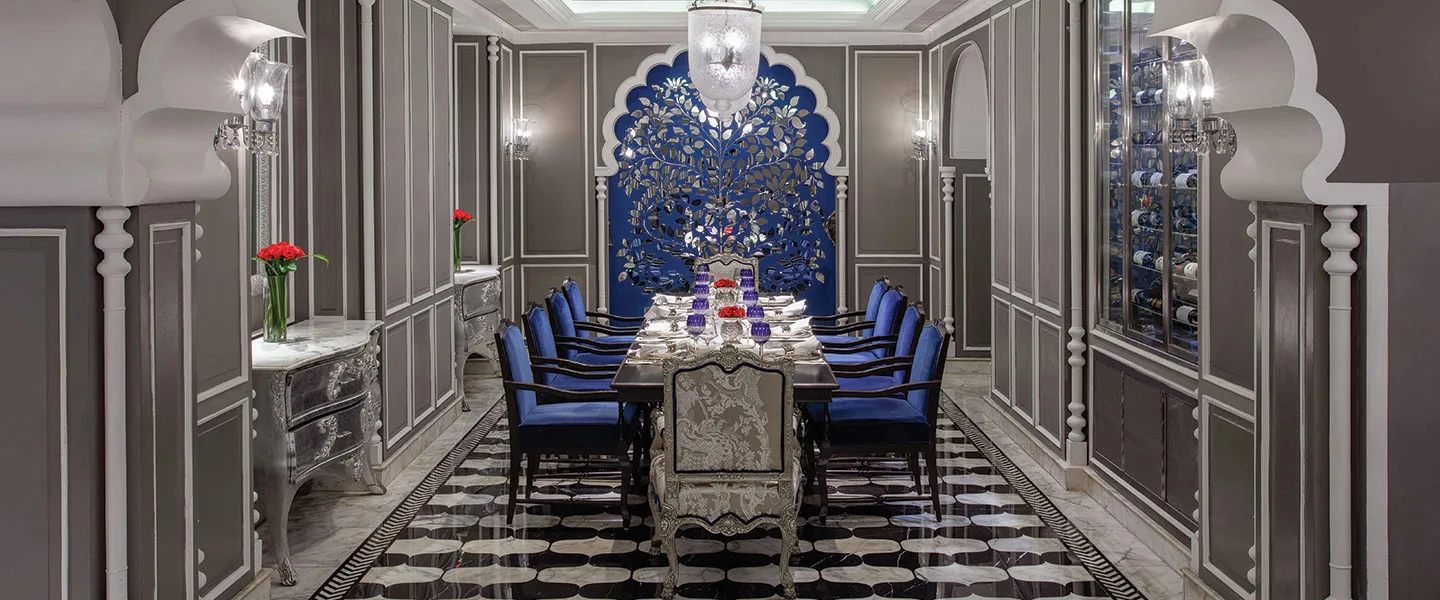
Dum Pukht is the Awadhi fine-dining restaurant inside ITC Maurya on Sardar Patel Marg in Chanakyapuri, New Delhi. The kitchen works the dum method the name refers to: meat, rice and spices go into a heavy handi that is sealed with dough and cooked slowly in its own juices, so the aroma stays locked in the pot until the lid is broken. The card follows the royal cooking of Awadh with kakori kebabs, biryanis, pulaos and soft breads, garnished with silver and gold varq and scented with saffron, rose water and dried fruit. ITC also draws on the kitchens of Bengal and Hyderabad, with dishes built on the same slow-cooked, layered spicing. The room is dressed in deep blue and silver: upholstered chairs, a long laid table, silver panelling, a mirrored arch and blue glassware, with piano music and a deliberately unhurried pace through the courses. Dinner is the formal sitting, and the house admits children above the age of eight only at dinner. Lunch runs for a little over two hours in the afternoon; dinner runs late into the night.
ITC presents the restaurant as the keeper of a culinary legacy rather than a single kitchen: the brand's chefs are described as inheriting a line that runs back to the personal cooks of the Nawabs of Awadh, and the menu keeps to the ingredients those kitchens prized. Dishes arrive in the order the house sets them, with kebabs and breads first and the sealed-pot biryani and pulao as the centre of the meal. Vegetarian cooking sits alongside the meat dishes rather than as an afterthought.
Service is designed around long dinners. Tables are laid with fine silverware, the lighting is low, and the pacing leaves room between courses. Guests are asked to request a table in advance through the hotel rather than turn up, and the house asks that children be over eight for the evening sitting.
The restaurant sits inside ITC Maurya in the Diplomatic Enclave, a short drive from Chanakyapuri's embassies and from the Delhi Ridge. The hotel's own dining directory describes the room as formal blue and silver, which is what the published photographs of the Maurya outlet show.
Tables are requested through the hotel's restaurant reservation form, which asks for a date, a time slot and the number of diners. The form places a request that the hotel confirms rather than holding a table immediately.
Indoor seating
A formal dining room with a long laid table, upholstered chairs and silver panelling.
Times Travel Editor
This March 2016 guide described a grand setting and slow-cooked food. It noted choices for vegetarians as well as meat eaters and recommended hara kebab and shahi nihari. These are historical recommendations, not confirmation of today’s menu.
Read original reviewOriginal paraphrase of Times of India Times Travel Editor; page last updated 15 March 2016 at 13:03 IST. Original publication date unconfirmed.
Nisha Shroff
Nisha Shroff’s January 2022 review praised the restaurant’s Lucknow-influenced cooking. Her meal included prawns, kakori kebab and chicken tikka, followed by rose kheer and shahi tukda. She described a rich, celebratory experience. The dishes, hours and prices in that article are historical.
Read original reviewOriginal paraphrase of Business Traveller, by Nisha Shroff, published 13 January 2022. No numerical score was published.
Shradha Shahani
In a December 2019 feature, Shradha Shahani described a dining room with embroidered furniture and Awadhi-style lamps. She highlighted the kakori kebab, chicken tikka, eggplant and Dum Pukht biryani. This historical account explains the restaurant’s style; it is not a current menu.
Read original reviewOriginal paraphrase of Condé Nast Traveller India, by Shradha Shahani, published 10 December 2019. The list position is an award placement, not a star rating.